Junji Ito is one of the most celebrated authors in the world of horror manga, known for works such as Uzumaki and Tomie, several of which have been successfully adapted into anime. Drawing inspiration from H. P. Lovecraft, his craft is widely acclaimed for its vivid portrayal of cosmic and supernatural horror.
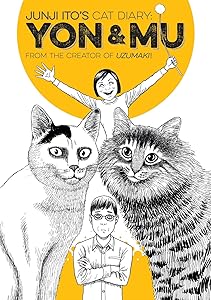
In Junji Ito’s Cat Diary: Yon & Mu, however, he takes a playful detour into light-hearted comic horror. The manga recounts how Ito bought a new house and invited his fiancée to live with him—only to discover she would be bringing her cats, Yon and Mu. Initially reluctant, Ito turns this situation into a 120-page tale where he comically depicts the “horrors” of life with the cats, charting his journey from irritation to affection.
What makes the book stand out is the way Ito portrays the evolution of his bond with Yon and Mu, presenting them as the true protagonists of each chapter. He shows how the cats became an essential part of his life and movingly recounts their journey up until their passing. The result is a story that blends humor, mild horror, and genuine heartbreak in equal measure.
With his distinctive linework and expressive character designs, Ito ensures that even this domestic story carries the same visual punch that defines his horror classics but in a comical fashion with a blend of love.
If you’re new to manga or to Junji Ito’s work, this book is a perfect entry point: a light-hearted, easy-to-read story that leaves you smiling while still showcasing his unique style.
Hi, all and welcome once again to Photon Quill ! This my second original story post and I would love your support – please give me feedback as what kind of content you would like next. I am planning to cover some book reviews and some original stories in near future. I would also like to write about some techs and tools that I use as a student. Stay tuned and please like, share, subscribe and comment to my posts ! Your support means a lot ! Now enjoy the story !
Kashi with the Enchanted Tree
The first time Kashi heard about the enchanted neem tree, he was eleven, hungry, and still brushing the chalk dust of school from his sleeves.
Kashi was taller than most boys his age, dark-skinned and wiry, with eyes that never seemed to rest on the ordinary. Where his classmates wrestled in the fields or skipped stones in the pond, Kashi stood apart, tracing patterns in the clouds or following the curl of a snake’s trail in the dust. His father, a weary schoolteacher, often muttered that the boy would grow up good for nothing—“a vegetable seller at best.” His mother, gentle and soft-spoken, shielded him with quiet affection, saving small coins to buy him toys or slipping an extra paratha onto his plate when she thought no one was watching.
Life in their village in India was not easy. Money was scarce, respect scarcer. Kashi had already learned the way neighbors measured worth by the size of a man’s house or the jewelry on his wife’s wrists. But for Kashi, the world was not made of money and debts—it was alive with mysteries.
So when he overheard his classmates whispering about a tree on the edge of the village—a neem tree that could grant any wish—his heart quickened. He knew at once he would find it. He imagined standing beneath its branches, asking not for sweets or toys but for bigger dreams: a stone house for his family, a warm coat for his father, enough intelligence to understand the secrets written in the shapes of clouds and leaves.
That evening, his mother stopped him on the path and handed him a plate of potatoes and parathas, the steam rising into the fading light. She smiled apologetically—she could never afford the milk powders and “growth mixes” the richer families fed their children. But to Kashi, nothing in the world tasted better than her food. He ate quickly, thanked her, and then, when she turned her back, slipped out into the night.
The path to the outskirts was already dark. Crickets sang, and every rustle in the grass sounded sharper than it should. He quickened his pace, clutching the edge of his shirt as though it could shield him from the night.
When he reached the grove, a line of trees rose like silhouettes against the moonless sky. Which one was the enchanted neem? His mother had tied threads around sacred trees before—he imagined he would find red and yellow strands glinting faintly in the dark. But here, all the trees looked the same, black and silent.
Kneeling beneath the largest trunk, Kashi pressed his palms together. “Please,” he whispered, “give my father a warm coat. Give my mother a house and jewelry, and give me enough wisdom to understand the world.”
The air shifted. A chill ran across his skin, and suddenly he felt he was not alone.
A voice slipped into his head, low and smooth, like oil poured in the dark. “Kashi… you are a bad boy. You ran away from home. Don’t you want to live with me instead? I will grant your wishes. I will take care of you. Come with me!”
Kashi’s eyes flew open. Just beyond the tree, something stirred—a shadow thicker than night, rising slowly into shape. It had no face, only a black outline that seemed to drink the light from the air.
And then came the words again, harder this time, inside his mind: “I won’t let you go back to your parents. I will take you with me!”
His legs trembled. He understood, with a certainty that felt carved into his bones, that this was not god or guardian, not the enchanted tree he had come seeking. This was something grotesque, something dark that fed on children’s longing. He should never have come.
The thing moved closer. Something cold and rough clamped around his left ankle. Kashi gasped, trying to wrench free, but the grip only tightened, searing his skin. Panic burst inside him. He shut his eyes and whispered the first prayer that came to his lips.
And then—he felt it. A faint glow. He opened his eyes and saw, just steps away, the neem tree, its trunk wound with sacred threads, its base lit by the dying flame of clay lamps left by the village women. Summoning all his strength, he dragged himself toward it. The grip burned at his ankle, but he reached out, fingers stretching desperately—
His hand brushed the sacred thread.
In that instant, the hold on his ankle vanished. He stumbled forward, crashing against the neem’s bark. His head struck hard, and the world dissolved into black.
When Kashi awoke, he was in his own bed. The morning light streamed through the window, and for a moment he wondered if everything had only been a dream. His mother was humming in the kitchen, and the smell of frying potatoes filled the room. Relief washed over him—until he shifted his leg.
A sharp sting shot through his left ankle. He pulled back the blanket and froze. Around the skin was a raw, circular mark, darkened as if burned by invisible hands. He touched it, and the memory of the shadow’s grip came rushing back.
Kashi never spoke of that night. Not to his parents, not to his friends. He carried the secret like a second shadow, hidden behind his daily routines.
Years passed. He became a teacher, like his father before him. He stayed in the village with his mother, caring for her after his father’s death. In the evenings, when the house grew quiet, he filled notebooks with stories—tales of strange voices, sacred trees, and the fine thread between danger and salvation.
But the mark on his ankle never faded. Even now, at twenty-five, it itches whenever he strays too close to the edge of the village, or when the night grows too still. Sometimes, lying awake, he wonders if the shadow still waits among the trees, whispering to children with curious hearts.
And sometimes, he closes his eyes and whispers back a thank-you—to the neem tree, to the faint light of the diyas, to whatever power it was that chose, on that night, to let him go.
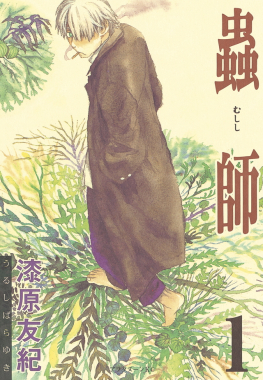
With an IMDb rating of 8.5/10, Mushi-Shi is one of the anime which delivers not only a calming and soothing sensation to its viewers but covers the supernatural and mysterious world of Mushi around the protagonist Ginko who is a Mushi-shi by profession. He travels around and helps people who are unaware of their world, their nature and presence and gets affected by them.
They are creatures only known as ‘Mushi,’ whose abilities range well into the supernatural. While their existence and appearances are unknown to the humans around them, there are a few like Ginko who is a ‘Mushi-shi’ that travels around to investigate and find out more about the ‘Mushi.’ During the course of his discovery and understanding, he helps those who are troubled by the Mushi themselves…
Both the manga and the anime is quite soothing and I believe a new manga series – collector’s edition is currently up for pre-orders on Amazon.
If you watch this series, watch one episode at a time rather than binge watching the whole to enjoy the experience. The episodes are a bit long and the story evolves in a slow paced way but the effects are quite calming, and soothing. Take my recommendation and watch it when you get time and leave your worries behind as you dive deep in the world of the Mushi and Ginko’s journey as Mushi-shi.

 Photon Quill